
What we produce

MALKOP

Yarns and threads

White and grey matt threads, linen threads and a tex 500 variant. Winding and composition matched to the customer's specification.
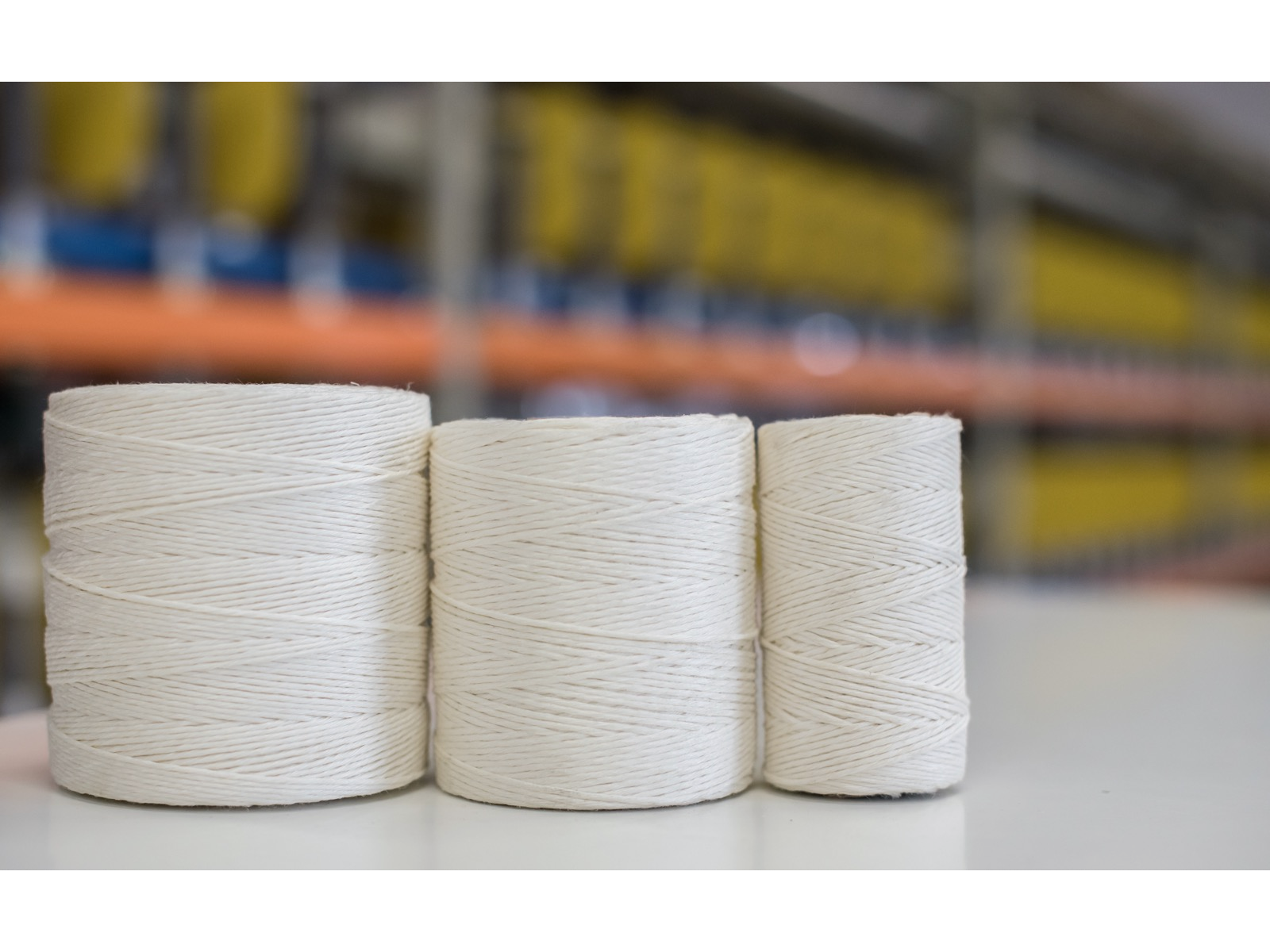
Yarns and threads from Malkop

Construction and supply

Matched to the process

Materials
Cotton
Construction
Threads and yarns by variant.
Linear density
Range includes tex 500 threads. Other counts depend on the variant.
Possible windings
Spools, windings and serial packaging.
Quantity and lead time
Quotation and lead time after confirming the variant, winding and batch size.

The sales catalogue includes matt and linen threads in windings described as 0.1 kg, as well as tex 500 threads. Tex expresses linear density, not diameter. A matt finish or colour does not determine composition; fibre, construction and tolerances are confirmed in the variant specification.

Yarn count and twist

Ne / Nm, linear density in tex, ply count and S/Z twist with TPM describe different product characteristics. Finished-cord diameter is specified separately.

Textile designations and the Ne 6/3 example
NeEnglish cotton count
Number of 840-yard hanks per pound of yarn. Higher count means lower linear density, not diameter in mm.
NmMetric count
Metres of yarn per gram. Nm and Ne are different systems; Nm 6 is not the same as Ne 6.
tex / dtexLinear density
tex: grams per 1,000 m; dtex: grams per 10,000 m. 1 tex = 10 dtex. State whether the value applies to a component yarn or the finished product.
PLYNumber of component yarns
Number of yarns combined at a given plying stage. Specify each stage of a cabled construction separately; ply is not the number of individual fibres.
S / ZTwist direction
Direction of the twist. For plied yarns, distinguish the component-yarn twist from the final plying twist.
TPM · turns/mTwist level
Turns per metre. TPI means turns per inch; 1 TPI ≈ 39.37 TPM. S or Z alone does not specify the twist level.
N / cN/texBreaking force / tenacity
Force at break and force relative to linear density. Comparison requires consistent test methods and conditions.
%Elongation at break
Change in length at break. This is not the same as an elastic cord's working extension.

Designation example, not a MALKOP product specification

Ne 6/3: three Ne 6 singles, or 3 PLY. Each single is approximately 98.4 tex; the nominal total is approximately 295.3 tex before twist contraction. By comparison, Nm 6 is approximately 166.7 tex.

Conversions: tex ≈ 590.6 / Ne (cotton); tex = 1000 / Nm. Yarn count does not convert directly to cord diameter.

Terminology references: CottonWorks: Ne, tex, Nm, PLYISO 2061Safilin: Nm, PLY

Applications and requirements

Typical applications

  • Textiles
  • Garment finishing
  • Auxiliary components
  • Recurring deliveries

Available options

  • Yarn count Ne / Nm
  • Linear density tex / dtex
  • Ply count
  • Twist S/Z and TPM
  • Composition
  • Finish
  • Winding

Documents

  • Product specifications
  • Documents on request
View technical data

Request for quote

Yarns and threads

Process-led selection

Application, machine and operating conditions form the starting point for selection.

Variant parameters

Diameter, construction, material, colour and winding are agreed before production.

Sample before series

For new applications we prepare samples for testing in the customer's process.

Documentation

Product sheet, specification and declarations for the selected product.